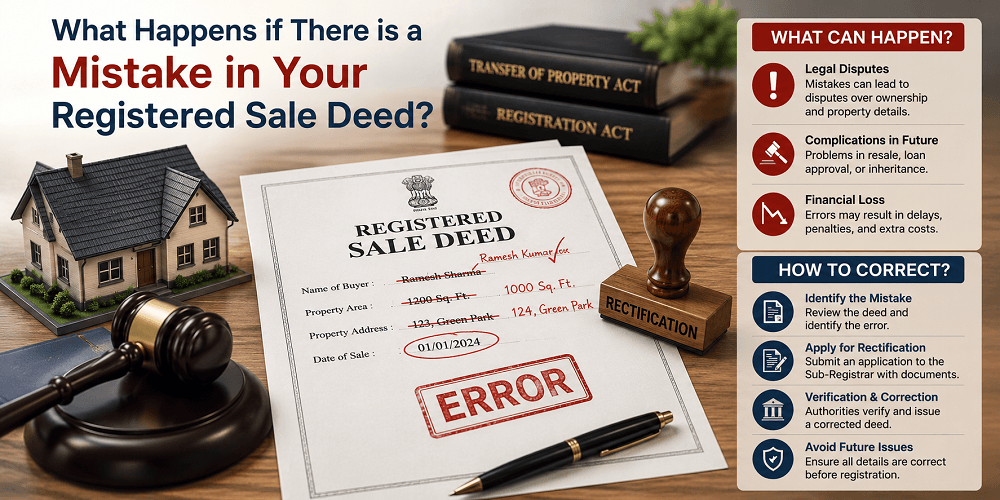
What Happens if There is a Mistake in Your Registered Sale Deed?
Discovering a typographical error, an incorrect survey number, or a misspelled name after completing your property registration can be an incredibly stressful experience for any property owner. According to Indian legal frameworks, a recorded error does not automatically invalidate your property ownership, but it creates severe bottlenecks when you try to apply for a home loan, secure a mutation certificate, or sell the asset in the future. To eliminate these legal vulnerabilities and ensure your property documents remain clean, accurate, and completely unassailable, you can rely on our comprehensive Sale Deed Registration Service in Pune to seamlessly execute the formal legal corrections. Resolving these inaccuracies through a structured legal framework requires executing an official amendment, commonly known as the rectification deed process.
Facing a Mistake in Registered Sale Deed: The Immediate Financial Risks
Discovering a mistake in registered sale deed documents can feel overwhelming, but understanding the real-world implications helps you take calm, decisive action. If your document carries a wrong survey number, incorrect property boundaries, or an error in the dimensions, the local revenue department (such as the Talathi or Circle Office in Maharashtra) will reject your property mutation application.
Without a clean mutation entry, you are not recognized as the official taxpayer for that property in government records. Additionally, banks and financial institutions scrutinize past title chains with extreme caution; even a single digit mismatch in a flat number or plot layout will result in an immediate rejection of your home loan application.
How to Fix Clerical Error in Property Documents Efficiently
Minor slip-ups happen more often than you think during the high-pressure environment of the sub-registrar's office. If you are wondering how to fix clerical error in property documents like minor spelling mistakes in an address, missed punctuation in a joint owner's name, or basic mathematical total mistakes in property measurements, the legal remedy is highly straightforward.
These minor issues are legally classified as "clerical or typographical errors" and do not alter the core substance, intent, or commercial value of the original transaction. They can be fixed quickly without requiring complex structural changes to your title chain.
Understanding the Legal Difference: Supplementary Deed for Property Correction
It is highly critical for property buyers to understand what can and cannot be fixed through a simple amendment. A supplementary deed for property correction is designed exclusively to fix unintentional mistakes made during the drafting stage of the original document.
| Parameter | Simple Rectification Deed | Major Supplementary Deed / New Sale Deed |
|---|---|---|
| Type of Error | Clerical, typing, spelling, minor boundary mismatches | Total change of property location or ownership structure |
| Stamp Duty Impact | Minimal or nominal government charges | Often calculated on prevailing market value |
| Intent of Parties | Remains identical to the original transaction | Changes substantially |
| Legal Nature | Correction of existing documentation | Functions as a new transfer instrument |
If the correction fundamentally changes ownership rights or substitutes one property for another, a simple rectification deed is generally not sufficient and a fresh conveyance document may be required.
Resolving a Typing Error in Property Registration Step-by-Step
When a data entry operator makes a typing error in property registration portals, it reflects directly on your final index-2 document. The process to rectify this requires both the original buyer and the original seller to come together in mutual agreement.
- Step 1: Drafting: Prepare a Rectification Deed clearly referencing the original registration number, execution date, and the exact mistake being corrected.
- Step 2: Explicit Correction: Clearly mention both the incorrect information and the corrected version for clarity.
- Step 3: Execution: Both parties should appear before the same Sub-Registrar Office where the original document was registered.
Understanding how these preliminary contracts link back to final rectifications becomes clear when analyzing the difference between sale deed and agreement to sale, as errors often originate in the initial agreement and carry over unchecked into the final registry.
Navigating the Official Rectification Deed Stamp Duty Rules
Many property owners delay fixing their documents because they fear massive government charges. According to current rectification deed stamp duty rules, if the mistake being corrected is a pure typographical or clerical error that does not increase the transaction value or change the size of the property, the stamp duty is nominal.
In states like Maharashtra, a minor clerical amendment can be recorded by paying a highly affordable fixed stamp duty fee plus basic registration processing charges. However, if the correction involves expanding the carpet area, adding an extra parking space, or upgrading the consideration value of the deal, the revenue department will charge full stamp duty on the differential market value.The Reality Check: Rectification Deed Timeline After Registration
Is there an absolute deadline to fix a mistake? While Indian law does not explicitly state a rigid rectification deed timeline after registration for clerical errors, waiting too long is a dangerous game. The ideal timeline to execute a correction is immediately upon noticing the discrepancy, preferably within a few weeks of collecting your original physical copies.
If you delay the process by 5, 10, or 15 years, your chances of a smooth correction drop drastically. Over time, original builders can close down their companies, individual sellers might relocate to another country, or an elderly property owner might pass away, making it incredibly difficult to secure the required signatures.
Completing an Amendment of Registered Documents Cleanly
To make an amendment of registered documents legally binding, the correction paperwork must mirror the exact legal weight of the original file. This means if your original conveyance was fully typed, signed, witnessed, stamped, and recorded by a government official, your amendment must undergo the exact same life cycle.
You cannot simply use white fluid, make handwritten corrections on the original sheets, or attach an unrecorded notarized affidavit to fix a property title. The sub-registrar must formally record the correction and create a cross-reference entry in their central database against your old registration number, ensuring that anyone pulling up your property's history sees the clean, updated title.
Ensuring the Ultimate Validity of Rectification Deed
A common question that surfaces during property corrections is whether the original witnesses must return to sign the new paperwork. Legally, the validity of rectification deed without witness presence from the original deal remains completely intact, provided you bring two fresh, valid witnesses with legitimate identity proofs to sign the new amendment.
The law requires the original parties (buyer and seller) to remain identical, but the individuals witnessing the signatures can be any competent adults available at the time of the new execution.
Exact Procedure for Correction of Property Boundaries in Sale Deed
A mismatch in property directions or borders can lead to severe boundary encroachment disputes with your neighbors. Executing a correction of property boundaries in sale deed documents requires submitting solid documentary proof to the sub-registrar.
You must back your claim using official government records, such as an approved layout plan from the city corporation, a certified survey map from the land records department (Bhumi Abhilekh), or a joint possession letter. The rectification deed must explicitly redefine the North, South, East, and West boundaries to ensure there is zero ambiguity regarding the exact physical limits of your land or flat.
Preparing for the Real Cost of Correcting Mistakes in Registered Sale Deed
Calculating the final budget before heading to the sub-registrar prevents unexpected financial surprises. The overall cost of correcting mistake in registered sale deed files includes the nominal government stamp duty, the official registration user fees, scanning charges per page, and professional legal drafting fees.
Investing in a precise, professionally drafted correction paper up front saves you from massive financial losses down the line, such as dealing with a stalled property sale or a canceled banking transaction due to a defective title chain.
Clean Up Your Property Titles with Absolute Confidence
Leaving a typographical error or an incorrect survey number on your registered property documents is a ticking legal time bomb that can freeze your asset's value instantly. Do not let a lazy drafting mistake turn into an expensive, multi-year court battle with uncooperative sellers or developers.
Reach out to our expert property lawyers at Sale Deed Pune today. We will analyze your current document errors, trace the original owners, handle the official sub-registrar drafting, and complete your rectification process seamlessly and safely.
Frequently Asked Questions (FAQs)
An incorrect survey number can create title and mutation issues. A properly executed Rectification Deed is usually required to correct the record and align it with official land documentation.
Yes, minor spelling mistakes in names, addresses, or property descriptions can usually be corrected by executing and registering a Rectification Deed at the Sub-Registrar Office with the consent of the concerned parties.
A rectification deed generally requires the participation of the seller or their legally authorized representative. If the seller is unavailable or deceased, legal remedies through the appropriate court may be necessary depending on the circumstances.
If the seller refuses to cooperate, the buyer may seek relief through a civil court by filing appropriate legal proceedings to request rectification of the registered instrument based on the facts and supporting evidence.
The overall cost may include nominal stamp duty, registration charges, scanning fees, and professional legal drafting fees. The exact amount depends on the nature of the correction and the complexity of the property records involved.