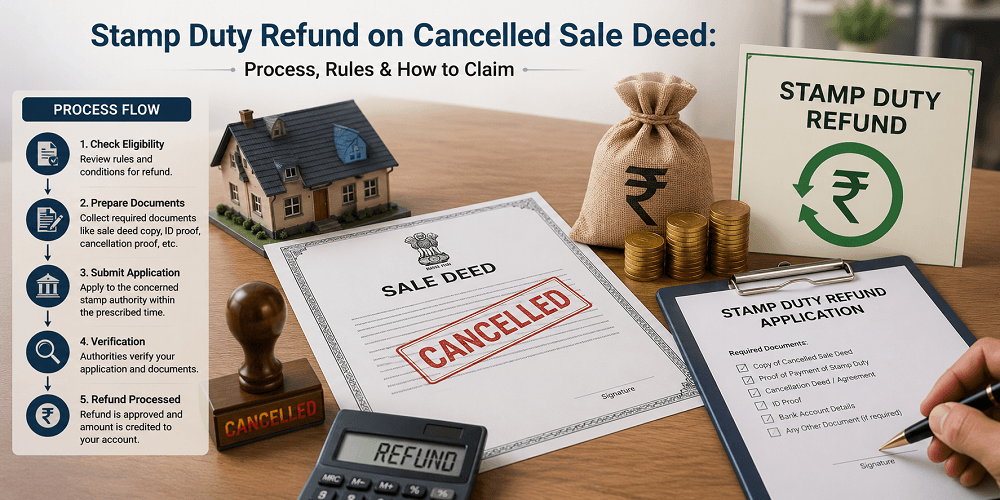
Stamp Duty Refund on Cancelled Sale Deed: Process, Rules & How to Claim
Walking away from a property transaction after parting with a life-changing amount of money is one of the most stressful experiences a homebuyer can face. Whether the deal collapsed due to a developer’s broken promises, severe construction delays, title defects, or an unexpected bank loan rejection, your primary focus shifts immediately from building a home to protecting your hard-earned financial investments. Fortunately, Indian state laws recognize that buyers should not be financially penalized for a failed property transaction, allowing you to claw back the substantial tax paid to the state treasury during the initial documentation phase. If your real estate deal has fallen through after initial registration, initiating a formal Cancellation of Agreement to Sale is the critical legal trigger required to unlock your financial recovery. Securing this money requires an absolute understanding of the timeline and procedure, which is why executing your cancellation paperwork through our expert Sale Deed Registration Service in Pune ensures compliance with state revenue guidelines and protects your eligibility for a maximum refund.
Understanding the Legal Grounds: Can Seller Cancel Agreement to Sell?
A property contract is a bidirectional legal lock, meaning neither side can arbitrarily terminate it without facing deep legal consequences. However, under specific statutory conditions, a seller does hold the right to revoke the arrangement. Understanding when and how a seller can cancel agreement to sell depends entirely on whether the buyer has committed a material breach of the mutually settled contract terms.
According to the Indian Contract Act, if a buyer completely fails to clear the remaining financial balance within the explicitly stated deadline, the seller can declare a contractual default. To execute this cancellation legally, the seller must issue a formal legal notice to the buyer, granting a reasonable cure period (usually 15 to 30 days) to rectify the financial default. If the buyer still fails to respond or perform their part, the seller can legally terminate the document and prepare to return the eligible funds under state law.
The Financial Shield: Exploring the Stamp Duty Refund on Cancellation of Sale Agreement
When a property deal falls apart after the state taxes have been paid, the single biggest financial worry for a buyer is the massive amount spent on stamp papers. Fortunately, state revenue departments offer a dedicated window for a stamp duty refund on cancellation of sale agreement, ensuring you do not lose this capital permanently.
To successfully claim this tax back from the government, the transaction must be explicitly dismantled using a registered cancellation instrument. According to recent legal precedents, including a landmark ruling by the Supreme Court of India, the application for this tax refund must be filed within a strict six-month window. This limitation clock starts ticking from the exact date the cancellation paperwork is executed by the parties, not from the date the document is registered. Missing this tight six-month statutory deadline means your right to claim the tax back from the state treasury is permanently lost.
The Master Process: Step-by-Step Guide on How to Get Stamp Duty Refund After Cancelling Property Agreement
The administrative journey to claim your money back from the government requires absolute documentary precision. To understand how to get stamp duty refund after cancelling property agreement, buyers must strictly adhere to a specialized electronic and physical verification workflow.
[Online Application on Portal] ➔ [Token Generation & Upload] ➔ [Physical Submission to Collector] ➔ [Verification & Bank Credit]
The process moves through these mandatory procedural steps:
- Online Application Filing: The applicant must log onto the state government's official land records or e-Treasury portal (such as the IGR Maharashtra Refund Module) to fill out the digital refund form.
- Document Upload & Token Generation: Scan and upload the original stamped instrument, the registered cancellation deed, identity proofs, and bank details to generate an official tracking token number.
- Physical Verification at Collector Office: Submit the physical originals of the cancelled agreement, the e-payment receipts, a signed indemnity bond, and a notarized affidavit to the district Collector of Stamps.
- Audit and Processing: The treasury department audits the authenticity of the stamp paper and the validity of the cancellation.
- Direct Bank Transfer: Once approved, the state treasury issues an order and transfers the amount directly into the buyer's registered bank account within 15 to 30 days.
The Refund Math: How Much Money Can You Reclaim?
The state does not keep your money if a transaction fails, but it does deduct a micro-percentage for administrative processing. The financial return is governed by strict statutory limits.
- Stamp Duty Refund Percentage: Whenever a registered deed or agreement is cancelled mutually, the state government processes a 98% refund of the total stamp duty paid. The state retains a minimal 2% as administrative processing charges.
- The Registration Fee Rule: It is critical to note that the registration fee (usually 1% of the property value or capped at ₹30,000) is 100% non-refundable. This money is treated as an instant consumption fee for utilizing the sub-registrar's logging infrastructure.
When Builders Back Out: Navigating Builder Agreement Cancellation Refund Rules
Canceling a project with an institutional developer involves a completely different set of structural timelines compared to individual secondary market transactions. Navigating the builder agreement cancellation refund rules requires a deep understanding of the statutory protections built directly into real estate regulatory frameworks across India.
When a buyer decides to pull out of a project due to verified false claims in the developer's marketing materials, unauthorized changes to the building layout, or extreme project delays, the developer cannot arbitrarily lock up your money. To ensure you understand where your transaction stands before initiating a formal cancellation, it is highly beneficial to review our comprehensive guide on the Sale Deed vs Agreement to Sale – Real Difference to analyze your exact contractual leverage and understand your positional strength.
Enforcing Consumer Protection: Analyzing RERA Rules for Booking Cancellation
The Real Estate (Regulation and Development) Act, 2016, fundamentally altered the balance of power between developers and retail buyers. Under the strict RERA rules for booking cancellation, a developer is legally bound to return the money collected from a buyer within a maximum window of 45 days from the date the cancellation is formally executed.
Furthermore, RERA frameworks explicitly state that a developer cannot collect more than 10% of the total property value as an advance booking amount without first executing and registering a formal Agreement for Sale. If a developer attempts to drag out this process or refuses to process your file, the buyer holds the immediate right to approach the state RERA authority to claim their complete refund along with a statutory interest rate (usually calculated as the State Bank of India's highest Marginal Cost of Funds Based Lending Rate plus 2%).
Recovering Broken Deals: Executing a Deed of Cancellation for Property
You cannot simply tear up a recorded contract or rely on casual verbal agreements when a real estate transaction breaks down. To completely erase the legal encumbrance on a property's title search records, both parties must execute a formal deed of cancellation for property.
This document functions as a mutual release contract. It must explicitly state the reasons why the original deal could not reach completion, specify the exact amount of advance money being returned to the buyer, and declare that neither party holds any residual claims, liens, or rights over the immovable asset moving forward. This document must be signed by both parties, witnessed, and formally recorded at the exact same sub-registrar office where the original property deal was initially logged to maintain clean public tracking records.
Resolving Disputes: Drafting a Token Money Refund Legal Notice
When a deal collapses because of a seller’s sudden uncooperativeness or a developer's defiance, buyers often find themselves chasing their booking amounts for months. If direct conversations fail, the first aggressive legal step is serving a structured token money refund legal notice to the defaulting party.
This notice must be drafted through a seasoned property lawyer and delivered via registered post. It must outline the chronological sequence of the transaction, highlight the specific clauses of the contract that the seller breached, and provide a strict 15-day ultimatum to return the earnest deposit in full. Serving this notice establishes an official paper trail that prevents the seller from claiming ignorance if you are forced to drag the dispute into a civil court or consumer forum later. To look at how these documentation steps culminate in a secure property transfer when things go smoothly, read our exhaustive checklist on the complete Sale Deed Registration Process in Pune for flats, plots, and villas to master your transaction safety.
Step-by-Step Breakdown of Property Cancellation Refunds
When processing a cancellation, state laws allow developers and revenue departments to retain minor administrative deductions. The table below outlines exactly what to expect financially across different cancellation scenarios:
| Refund Component | Maximum Statutory Deductions Allowed | Standard Settlement Timelines | Governing Authority |
|---|---|---|---|
| State Stamp Duty Tax | 2% administrative deduction from the paid duty | 3 to 6 calendar months | State Revenue Department / Collector of Stamps |
| RERA Booking Advance | Maximum 10% of the token amount (only if buyer defaults) | Within 45 days | State Real Estate Regulatory Authority |
| Registration Fees | 100% Non-Refundable across most Indian states | Immediate forfeiture | Sub-Registrar of Assurances |
Essential Document Checklist for a Successful Refund Claim
To prevent the Collector of Stamps from rejecting your application due to missing proof, gather these essential documents before filing:
- Original Registered Document: The original registered Agreement to Sell or Sale Deed that is being cancelled.
- Registered Cancellation Deed: The formally recorded Deed of Cancellation signed by both parties.
- Payment Receipts: Original e-challan receipts or physical stamp duty receipts proving the tax was paid to the treasury.
- Identity Verification: Aadhaar Card and PAN Card of the applicant seeking the refund.
- Banking Proof: A cancelled cheque or updated bank passbook copy matching the refund application name for direct bank transfer.
- Formal Claim Forms: Duly filled and signed Form 66 / Form 67 or equivalent forms prescribed by the applicable state authority.
Secure Your Refund Safely with Trusted Legal Professionals
Allowing your property cancellation documents to sit unmonitored or missing the strict government refund deadlines can put your hard-earned savings at risk. Even a minor technical error in your cancellation paperwork can result in delays or rejection of your refund application.
Connect with our dedicated legal team today for assistance with document verification, cancellation deed drafting, and end-to-end support through our Sale Deed Registration Service in Pune.
High-Intent Voice Search FAQs
Subject to the terms of the agreement and applicable regulations, a builder may deduct a portion of the booking amount when cancellation occurs due to a buyer's default. The exact amount depends on the contract and governing laws.
You may issue a formal legal notice, file a complaint before the appropriate RERA authority, or approach a Consumer Disputes Redressal Commission to seek recovery of the amount along with applicable interest and compensation.
Generally, you must execute a registered cancellation deed, submit the prescribed online application within the applicable deadline, and provide supporting documents to the relevant stamp authority for verification and refund processing.
Depending on the circumstances and applicable tax regulations, eligible homebuyers may be able to claim a GST refund through the prescribed process. Documentation requirements and timelines should be verified before filing a claim.
Yes, in certain circumstances a registered sale deed may be cancelled by mutual consent through a properly executed and registered Deed of Cancellation, subject to applicable legal requirements and the facts of the transaction.